How Aristarchus of Samos measured the distance to the Sun more than 2000 years ago
Aristarchus of Samos lived approximately from 310 to 230 BC, long before Copernicus and any precise measuring instruments. But back then he had a brilliant idea of how to roughly estimate the distance to the Sun.
The thing is, in trigonometry (which didn't exist yet!) if you know the length of one side of a triangle and the values of two angles, you can determine the length of all sides. Aristarchus roughly determined the distance from Earth to the Moon through lunar eclipses. He also measured angle B approximately. But measuring the second angle was impossible without being on the Moon or the Sun.
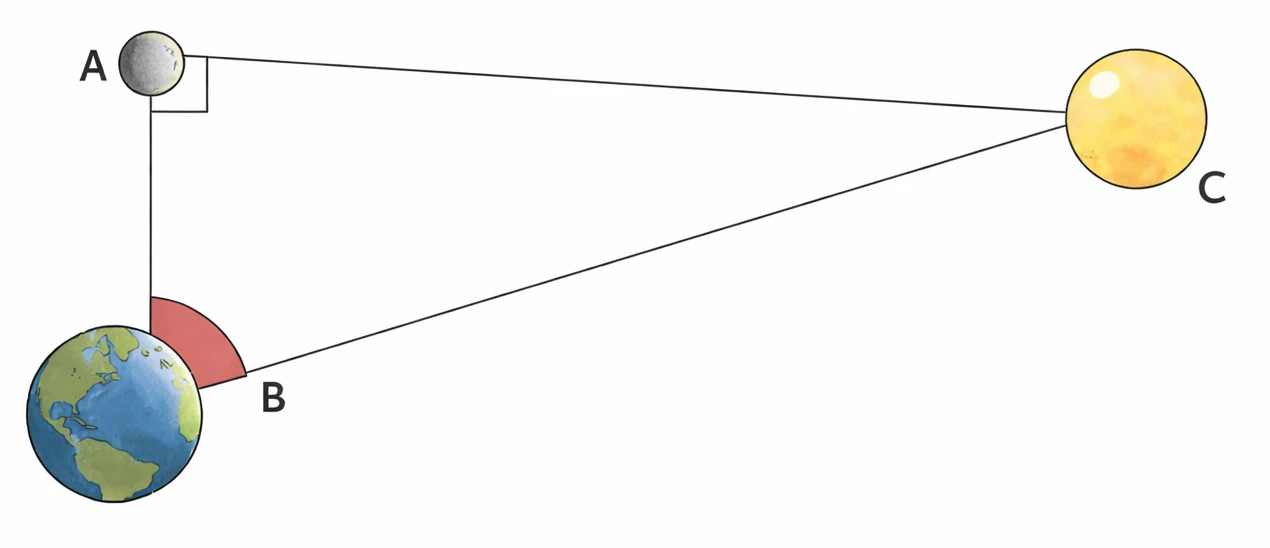
His insight was that when the Moon looks like a half moon (half illuminated), at that moment the ray from the Sun to the Moon is perpendicular to the line between Earth and Moon, meaning angle A equals 90 degrees. Aristarchus measured angle B from Earth — he got approximately 87 degrees.
In the end, he underestimated the value from the real one by about 20 times, but precisely because of many very approximate data points.